
Why do profiles become brittle? I will show you in this article.
For quite some time, the brittleness of plastic profiles has been a persistent issue hindering the normal operations of various profile manufacturing enterprises. Whether judged by the visual appearance of the cross-section or the level of acceptance among door and window assembly plants, profile brittleness invariably—and to varying degrees—negatively impacts these companies’ market share and corporate reputation. Fundamentally, profile brittleness is fully manifested in the compromised physical and mechanical properties of the finished products. Its primary symptoms include chipping or splintering during the cutting process, and cracking under cold punching. There are numerous factors contributing to the poor physical and mechanical performance of profile products; these causes are predominantly categorized into the following types:
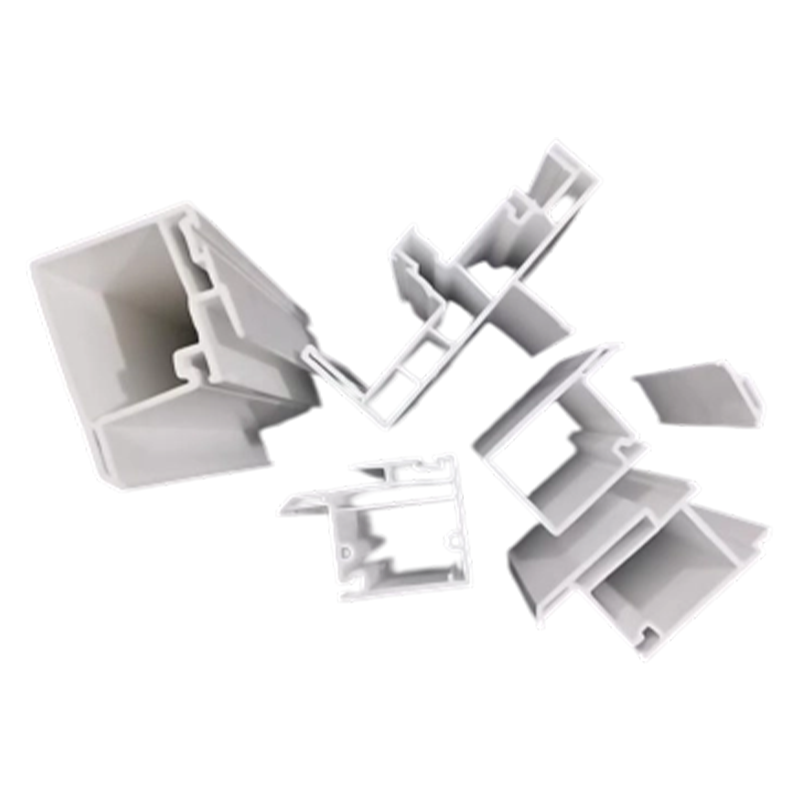
A specific scenario worth discussing arises when profile samples meet all standards—such as those for cold impact resistance, corner weld strength, and dimensional stability after heating (per GB/T 8814-2004)—yet slight, subtle chipping (or “breakout”) still occurs at the cut edges during the cutting process, particularly on the internal ribs.
One school of thought attributes this phenomenon to external factors, specifically:
(1). The ambient temperature during fabrication is below 12°C; this not only causes chipping during cutting but also adversely affects properties such as corner weld strength;
(2). The saw feed rate is too high during cutting (often indicated by a sharp, rapid sound from the saw);
(3). The saw blade is worn out or has missing teeth.
Another perspective holds that the issue lies with the profile itself—specifically its formulation or the extrusion process. The author believes that a combination of these factors is likely at play. Furthermore, there is the matter of balancing rigidity and flexibility; finding the optimal equilibrium point between these properties is the key to resolving the issue.
(1) The impact of the formulation system on rigidity and flexibility metrics: adjusting rigidity—whether increasing or decreasing it—inevitably requires altering the filler content, which in turn directly affects flexibility. Excessive filler leads to failure in cold impact tests and reduced weld strength, while insufficient filler results in excessive dimensional instability. Similarly, adjusting flexibility—by modifying the content of impact modifiers or processing aids—directly impacts rigidity. An excess of processing aids reduces rigidity, whereas a deficiency increases it; thus, these factors represent a contradictory yet unified relationship of mutual constraint within the formulation. However, it is unreasonable to attempt to enhance rigidity while maintaining flexibility simply by indiscriminately increasing processing aids alongside fillers. Therefore, an optimal balance point must be established within the formulation system to achieve the right equilibrium between rigidity and flexibility.
2) The influence of the extrusion process on profile rigidity and flexibility. The extrusion temperature setting is a key factor affecting the degree of material plasticization. Excessive plasticization causes the decomposition and volatilization of low-molecular-weight polymers within the material; the resulting changes in intermolecular structure lead to increased rigidity and reduced flexibility. Conversely, insufficient plasticization—where the molecules of the various components have not fully fused—results in lower rigidity and prevents the material’s flexibility from being fully realized. Screw torque and extrusion pressure are directly proportional to profile rigidity, increasing as torque and pressure rise. In contrast, flexibility is inversely proportional to these parameters, decreasing as torque and pressure increase.
It should be noted that, during the initial startup of extrusion, instances occasionally occur where profiles show no signs of edge chipping or cracking, yet slight bubbling is observed in the internal ribs—presenting a new issue. Three hypotheses have been proposed:
(1). The processing temperature for this type of profile needs to be higher than the standard operating temperature; if the initial setting was too low, the profile would be under-plasticized. To raise the processing temperature without causing the internal ribs to foam, the dosage of stabilizer should be appropriately increased; naturally, this also depends on the extrusion speed—specifically, the residence time of the material within the barrel.
(2). If the screw core temperature is excessively high, the issue is easier to resolve: simply lower the screw core temperature accordingly.
3). The main unit’s vacuum system is not turned on, or the vacuum level is too low. If this is the case, the profile’s condition after heating will be substandard; however, if the condition after heating is satisfactory, then the issue must lie with one of the two previously mentioned problems.
This implies that even if all test metrics for the profiles meet specifications, it does not guarantee the absolute soundness of your formulation system or extrusion process; a minor oversight could occur at any stage. Therefore, when investigating any issue, we must take a holistic view rather than hastily attributing the problem to a specific point or aspect—which could lead to pointless debate. Instead, we should adopt a rigorous scientific approach, systematically troubleshooting and carefully evaluating each factor. When addressing such issues, we must establish a baseline and stabilize it before we can effectively investigate whether other factors are problematic.