
High-speed profile extrusion dies are critical tooling used in the high-speed extrusion of plastic or metal profiles. They are widely applied in products such as window and door profiles, pipes, decorative trims, and industrial structural components. The core objective is to increase production efficiency while maintaining dimensional accuracy and surface quality.
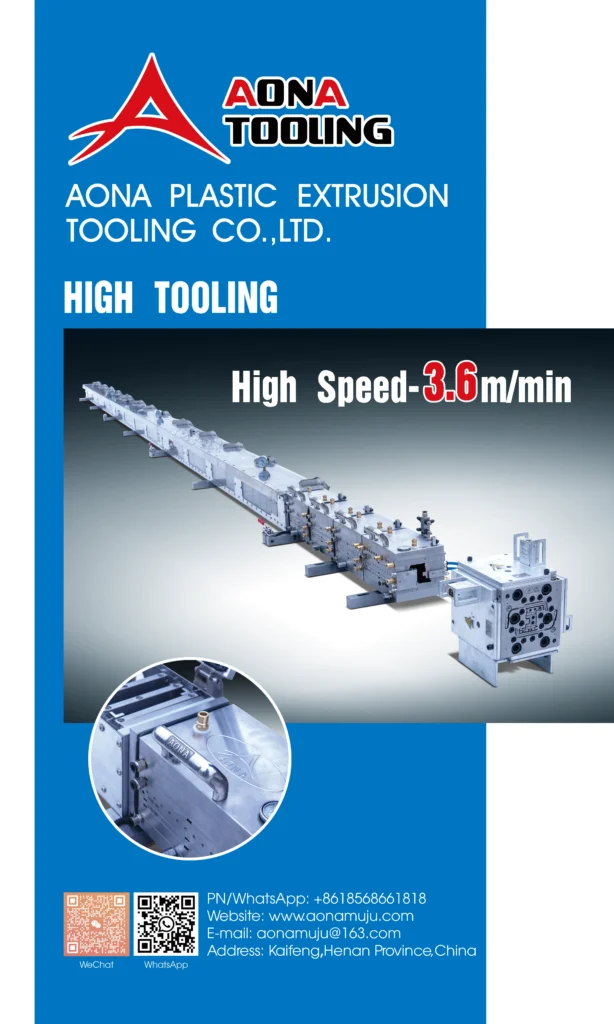
1. What Is a High-Speed Profile Extrusion Die?
A profile extrusion die is installed at the head of an extruder. It shapes molten materials (such as PVC, aluminum, PE, etc.) through guiding, distributing, forming, and cooling, producing continuous profiles with specific cross-sections.
“High-speed” means:
- Higher extrusion rates (20%–100% faster than conventional dies)
- Greater demands on flow channel design, cooling, and materials
2. Main Structure of the Die
A typical high-speed extrusion die includes:
1. Flow Distribution System (Runner System)
- Distributes molten material evenly into different sections
- Common designs: coat-hanger type, branch runners
- Key point: balanced flow, no dead zones or material stagnation
2. Forming Zone (Die Lip / Cavity)
- Determines the final cross-sectional shape
- Requires high machining precision (typically ±0.01 mm)
3. Calibration System (Sizing Die / Cooling Die)
- Uses vacuum and cooling water for rapid shaping
- Prevents deformation and uneven shrinkage
4. Support and Alignment Structure
- Prevents deflection or twisting during high-speed extrusion
3. Key Features of High-Speed Extrusion Dies
✅ 1. Optimized Flow Channel Design
- Uses CAE simulation (flow analysis)
- Ensures uniform material flow at high speed
- Prevents:
- Visible weld lines
- Uneven pressure
- Local overheating
✅ 2. Efficient Heat Dissipation
- High speed leads to higher heat buildup
- Requires:
- Optimized internal cooling channels
- High thermal conductivity materials
✅ 3. High Wear Resistance and Long Service Life
Common materials:
- DIN1.2316 steel
- 3Cr17 steel
Features:
- High temperature resistance
- Corrosion resistance (especially for PVC)
- Wear resistance
✅ 4. High Machining Precision
- CNC machining + wire EDM + polishing
- High surface finish requirements (Ra ≤ 0.4 or better)
✅ 5. High Stability
Under high-speed production, the die must:
- Maintain shape without deformation
- Avoid material blockage
- Run continuously for long periods (24h+)
4. Differences from Conventional Extrusion Dies
| Item | Conventional Die | High-Speed Die |
|---|---|---|
| Extrusion Speed | Medium/low | High-speed continuous |
| Flow Design | Experience-based | Simulation-optimized |
| Cooling | Standard | Enhanced cooling |
| Cost | Lower | Higher |
| Stability | Moderate | High stability |
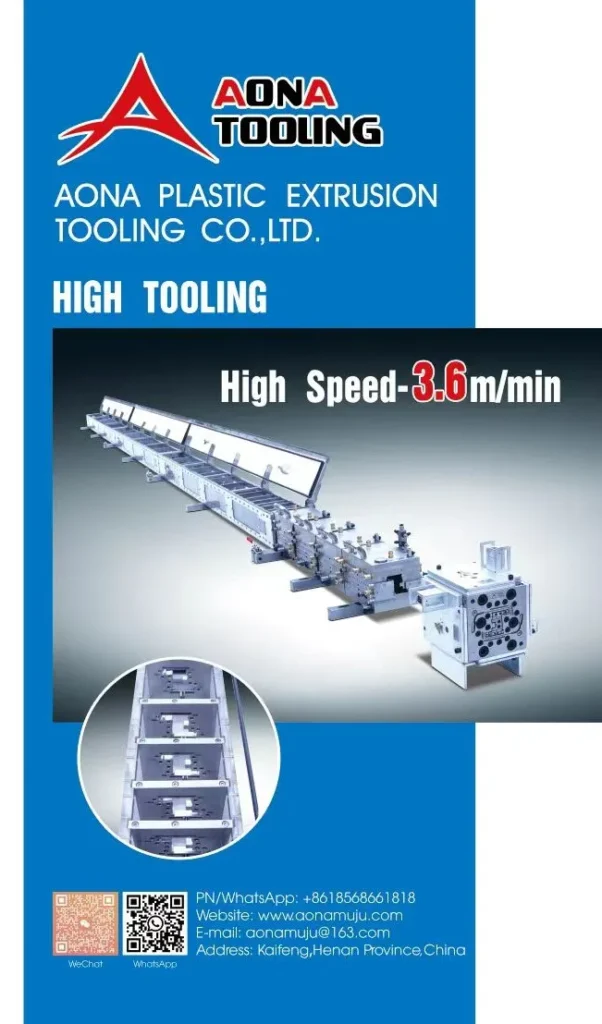
5. Applications
High-speed extrusion dies are commonly used in:
- PVC window and door profiles
- Aluminum profiles
- Plastic pipes (PE/PPR)
- Decorative trims
- Cable sheathing
- Industrial structural profiles
6. Design Challenges
Key challenges include:
- Flow Balance
- Different wall thicknesses cause uneven flow
- Weld Line Control
- Affects appearance and strength
- Thermal Expansion
- Dimensional changes at high temperatures
- Vacuum Calibration Matching
- Extrusion speed must match cooling capacity